At Rilegr, we help businesses leverage the power of technology, AI, and digital transformation to achieve growth and long-term success. By combining human expertise with advanced digital solutions, organizations can unlock new opportunities and thrive in the modern business landscape.
Rilegr
Head Office: Rilegr HQ, Jind, Haryana, India
Email: contact@rilegr.com
Website: www.rilegr.com
In today’s rapidly evolving digital world, Artificial Intelligence (AI) is transforming the way businesses operate. From automating repetitive tasks to generating valuable insights from large datasets, AI has become an essential tool for organizations seeking growth and efficiency. However, the most successful businesses are not those that replace people with AI—they are the ones that combine human intelligence with artificial intelligence to create stronger, smarter, and more innovative organizations.
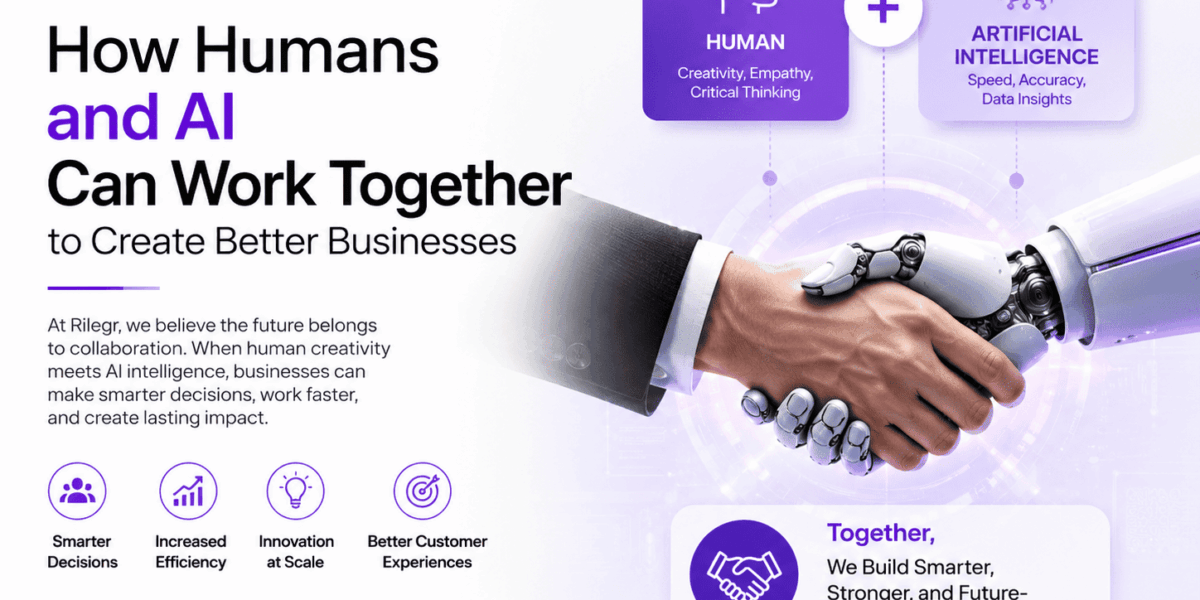
At Rilegr, we believe that the future of business lies in effective human-AI collaboration. When people and technology work together, businesses can improve productivity, enhance customer experiences, drive innovation, and achieve sustainable growth.
Understanding Human-AI Collaboration
Human-AI collaboration is the partnership between human expertise and AI technologies to achieve better outcomes than either could accomplish alone. AI excels at processing vast amounts of data, identifying patterns, automating repetitive tasks, and providing predictive insights. Humans, on the other hand, bring creativity, emotional intelligence, critical thinking, ethical judgment, and strategic decision-making.
Rather than viewing AI as a replacement for employees, businesses should see it as a powerful assistant that enhances human capabilities.
Why Human-AI Collaboration Matters
Businesses today face increasing competition, changing customer expectations, and growing operational complexities. AI helps organizations respond faster and more efficiently, while humans provide the creativity and judgment necessary to navigate uncertainty and build meaningful relationships.
Research shows that organizations achieve the greatest value from AI when it supports human workers rather than simply automating jobs. Companies that focus solely on cost-cutting often miss AI’s broader potential for innovation and business growth.
Key Areas Where Humans and AI Work Together
1. Smarter Decision-Making
Business decisions require accurate information and strategic thinking. AI can analyze market trends, customer behavior, financial data, and operational performance in real time. Human leaders can then use these insights to make informed decisions.
For example, AI may identify emerging customer preferences, but business leaders determine how to adjust products, services, and marketing strategies accordingly.
This combination results in faster and more accurate decision-making while reducing the risk of human error.
2. Enhanced Customer Experience
Modern customers expect personalized and immediate service. AI-powered chatbots, recommendation systems, and customer support tools can handle routine inquiries around the clock.
However, complex issues often require empathy, understanding, and personalized attention that only humans can provide. By combining AI efficiency with human care, businesses can deliver exceptional customer experiences. Organizations that successfully integrate AI into customer service often see higher customer satisfaction and improved service quality.
3. Increased Productivity
One of AI’s greatest strengths is automating repetitive tasks such as data entry, scheduling, reporting, document processing, and inventory management.
When employees spend less time on routine work, they can focus on strategic activities such as innovation, relationship building, problem-solving, and business development.
Many businesses report significant productivity improvements when AI is used to streamline workflows and eliminate manual processes.
4. Accelerated Innovation
Innovation is the foundation of long-term business success. AI can quickly analyze market trends, customer feedback, and industry developments to identify opportunities for new products and services.
Humans then use creativity and experience to transform these insights into innovative solutions.
AI can assist with brainstorming, research, content creation, and prototype development, helping businesses bring ideas to market faster than ever before.
5. Better Marketing Performance
Marketing has become increasingly data-driven. AI helps businesses analyze customer behavior, segment audiences, personalize campaigns, and predict future buying patterns.
Human marketers use these insights to create compelling messages, build brand identity, and connect emotionally with customers.
The result is more effective marketing campaigns that deliver higher engagement and better returns on investment.
6. Stronger Employee Performance
AI can support employees by providing recommendations, automating administrative tasks, and offering real-time assistance.
Instead of replacing workers, AI enables them to perform their jobs more effectively. Employees can focus on high-value activities that require human creativity and judgment while AI handles repetitive and time-consuming tasks.
This often leads to greater job satisfaction and improved employee experiences.
The Human Skills AI Cannot Replace
Despite its impressive capabilities, AI has limitations. Successful businesses understand that certain human skills remain irreplaceable:
- Creativity and innovation
- Emotional intelligence
- Leadership
- Strategic thinking
- Ethical judgment
- Relationship building
- Negotiation skills
- Cultural understanding
- Complex problem-solving
These uniquely human abilities complement AI technologies and create a powerful competitive advantage when combined effectively.
Building a Successful Human-AI Business Strategy
Invest in Employee Training
Businesses should equip employees with AI knowledge and digital skills. AI literacy enables teams to use technology effectively and confidently.
Organizations that prioritize workforce development often achieve stronger business results and greater adaptability.
Redesign Workflows
Simply adding AI tools to existing processes may not generate significant results. Businesses should redesign workflows to maximize collaboration between people and technology.
Research suggests that organizations achieve better outcomes when AI is integrated into business processes rather than layered onto outdated systems.
Maintain Human Oversight
AI systems should always operate under human supervision. Important business decisions require human accountability, ethical judgment, and contextual understanding.
Human oversight helps ensure accuracy, fairness, and trust in AI-driven operations.
Encourage Innovation
Businesses should create a culture where employees view AI as a collaborative tool rather than a threat. Encouraging experimentation and innovation helps organizations discover new ways to create value.
The Future of Human-AI Collaboration
As AI technologies continue to evolve, businesses will increasingly rely on collaborative models where humans and AI work together seamlessly. Future workplaces will likely feature AI assistants that help employees manage projects, analyze data, generate content, and support decision-making.
The organizations that succeed will not be those that choose humans or AI. They will be the businesses that combine the strengths of both to create more value, improve customer experiences, and drive innovation.